Why is Bordeaux called the Port of the Moon?
The name comes from the crescent-shaped bend of the Garonne, and it runs from the medieval arms of the city to its modern logo and its UNESCO listing. Here is where to see the curve, and why the river is the color of caramel.
Read on
The short answer
Because of the river. The Garonne makes a wide bend as it passes Bordeaux, and the city grew up on the outside of that bend, on the left bank, where the curve of the quays draws a crescent. Since the Middle Ages the harbor has been called the Port de la Lune, the Port of the Moon, after that crescent shape, and the name has stuck to the city ever since.
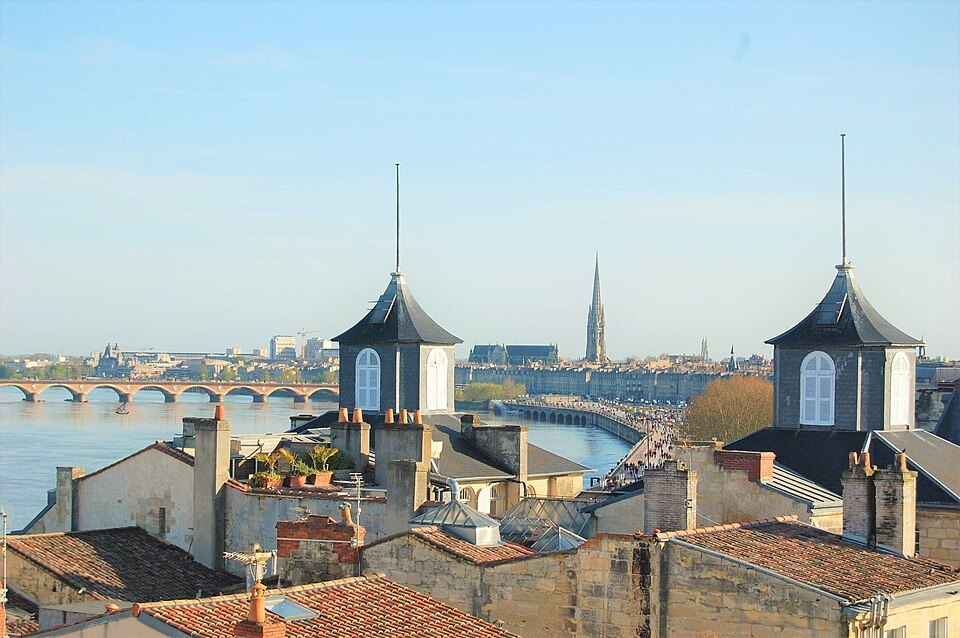
You will meet the moon everywhere once you know to look for it: on the city's coat of arms, in its monogram of three interlaced crescents, in the logo of the town hall, and since 2007 in the name under which Bordeaux is inscribed on the UNESCO World Heritage List, Bordeaux, Port of the Moon.
A crescent drawn by the river
At Bordeaux the Garonne is broad, and it is tidal. The ocean's tide reaches far up the river, well beyond the city, and at low water in dry spells salt water from the ocean comes up as far as Bordeaux. The river curves around the old city from south-east to north-east, and the long, even line of stone façades along its left bank follows the curve, which is why the city front seen from across the water looks like a crescent.
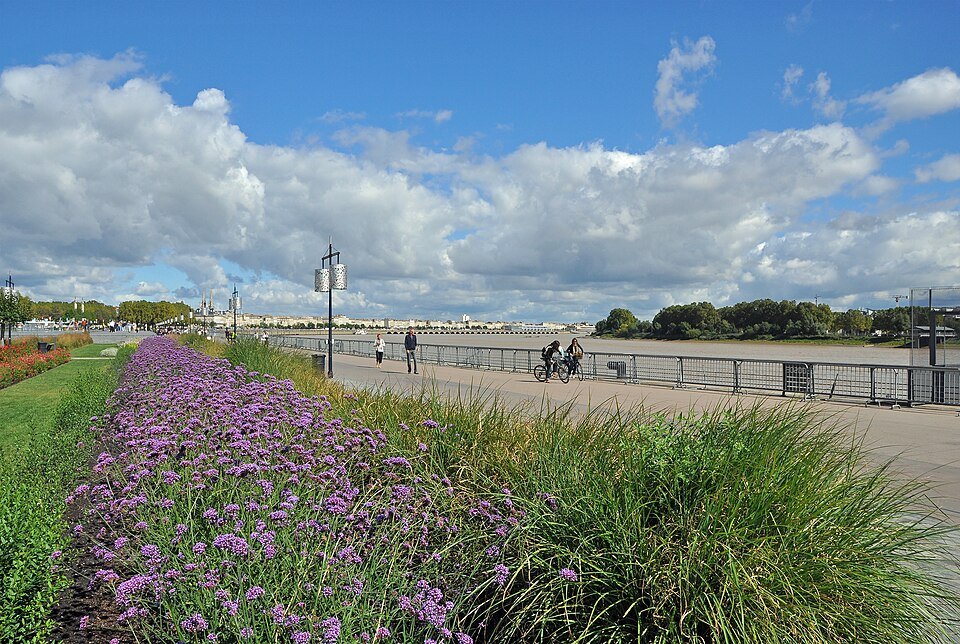
The curve also explains the city's shape. Merchant ships moored along the outside of the bend, where the current keeps the channel deep, and the port, the warehouses and then the grand eighteenth-century façades were built along that deep-water edge. The low, marshy right bank opposite was developed much later. Even now, ocean-going ships come up the Gironde estuary and the tidal Garonne as far as the Pont de Pierre, the old stone bridge at the southern end of the crescent.
Why the water is the color of caramel
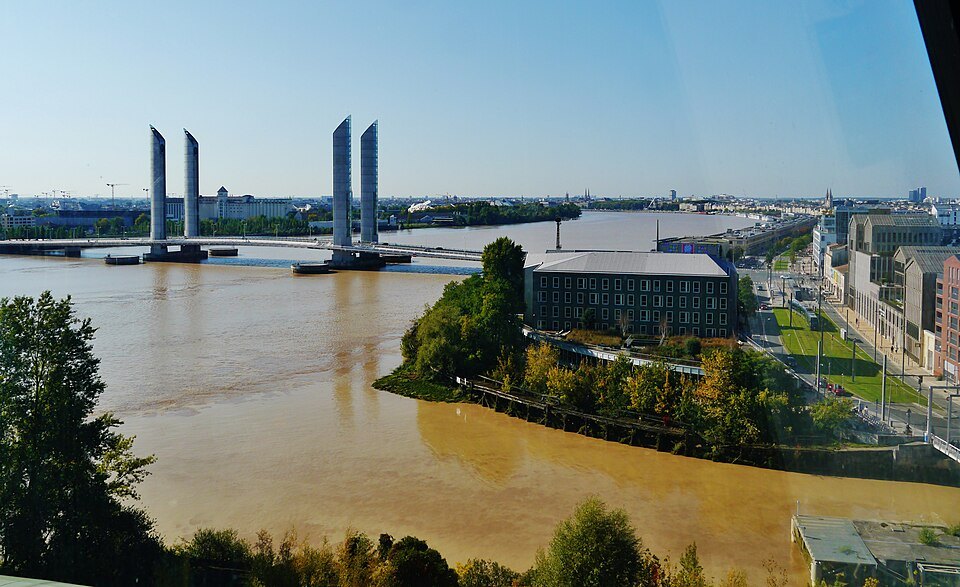
Visitors often ask why the Garonne at Bordeaux is brown. Upstream, from its source down to the edge of the Lot-et-Garonne, the river is usually green to blue; as it enters the Gironde it turns the color of caramel. The reason is the meeting of fresh river water laden with clay and the tide pushing up from the sea, which reaches as far as La Réole. The fine clay particles clump together and the tidal currents keep stirring them back into suspension, so the river stays thick with silt through the city.
The same tide produces one of the Garonne's curiosities: a tidal bore, the mascaret, a wave that runs upstream as the tide comes in. The Garonne is one of the few rivers in the world where this happens, and in big tides the wave can be seen upstream of Bordeaux, beyond Cadillac, with surfers riding it. It is not something you will see from the city's quays, but it is the same tide that raises and lowers the river along the crescent twice a day.
The moon on the arms
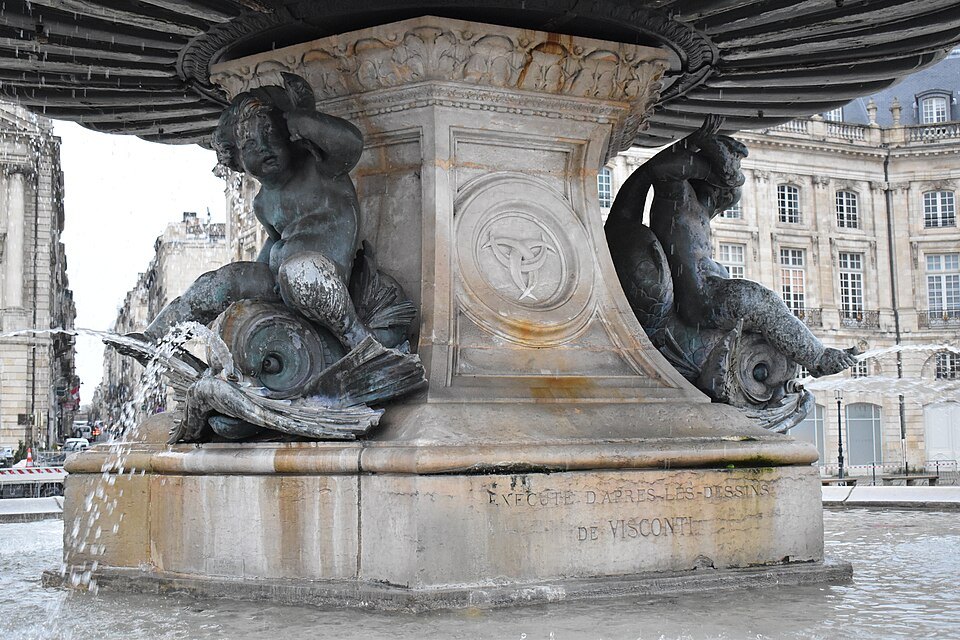
The crescent has been part of Bordeaux's image for a very long time. The earliest arms of the city go back to the twelfth century, under Richard the Lionheart, and they already show a crescent moon in the waters of the Garonne to stand for the port. In the seventeenth century the city's monogram appeared, three crescent moons interlaced, and the modern logo of the city is a stylized view of the Port of the Moon.
The moon has outlived the port that gave it its name. The harbor in front of the old city no longer handles cargo, but the crescent is still the city's emblem, and the name Port of the Moon now belongs to the whole historic city on the World Heritage List.
The port that moved away
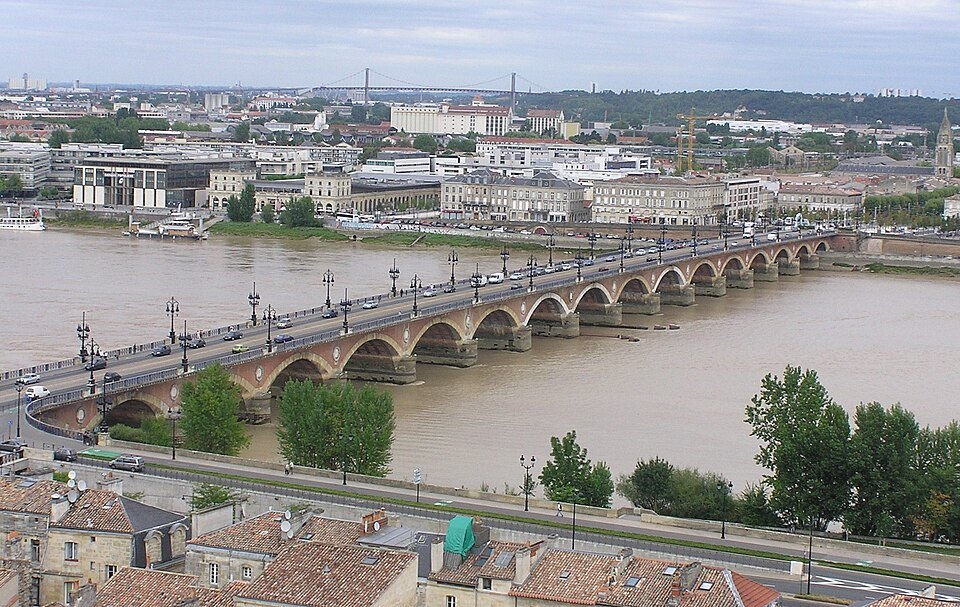
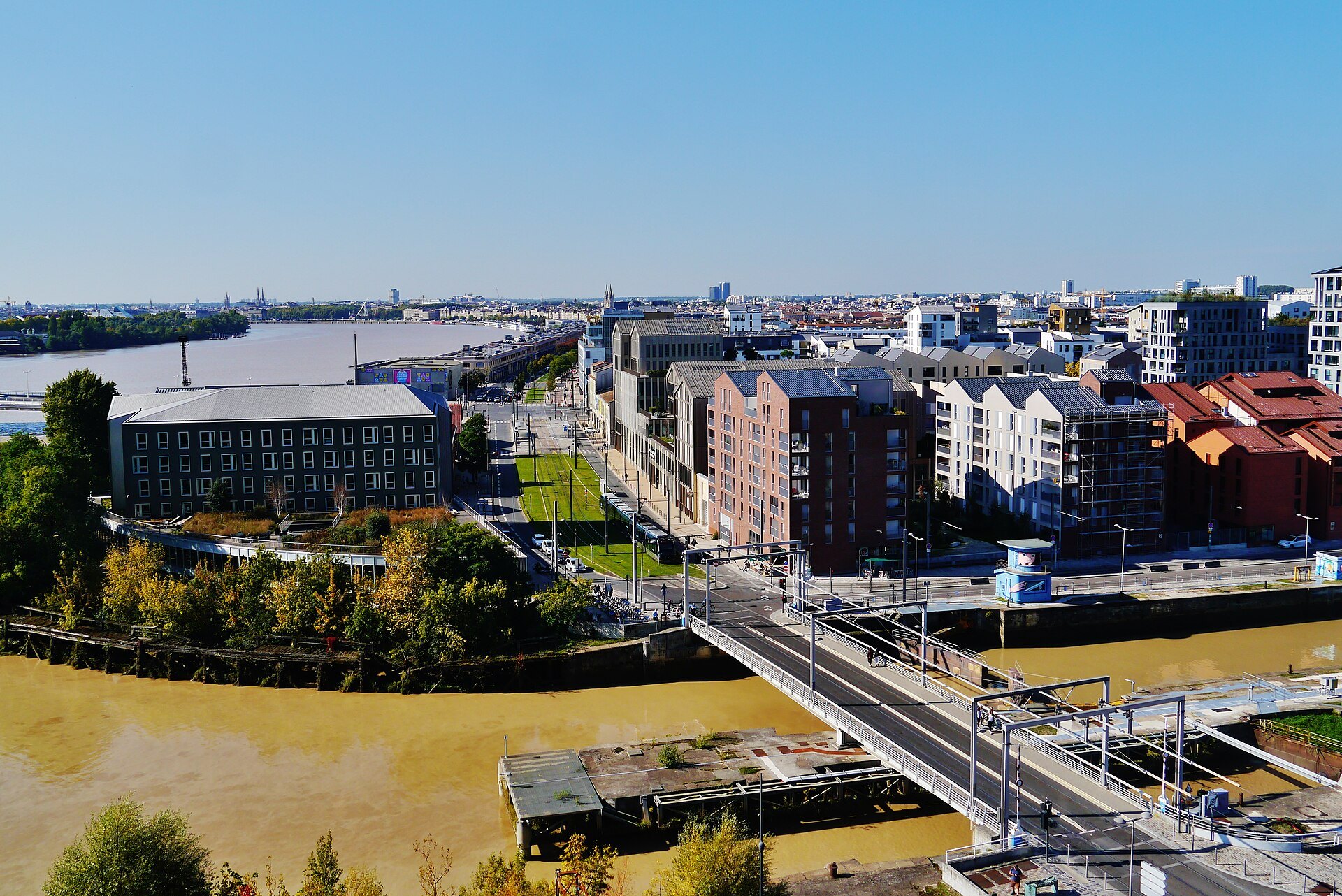
Today the Port of the Moon itself, the stretch of river in front of the city sometimes called the roadstead of Bordeaux, is mostly a harbor for tourism: cruise ships, tall ships and river boats. The commercial port moved downstream many years ago, to sites at Bassens, Pauillac, Blaye and Le Verdon nearer the sea. North of the old center, the Bassins à Flot, two locked basins built to keep ships clear of the tides, show the last stage of the old city port and are now being rebuilt as a new quarter.
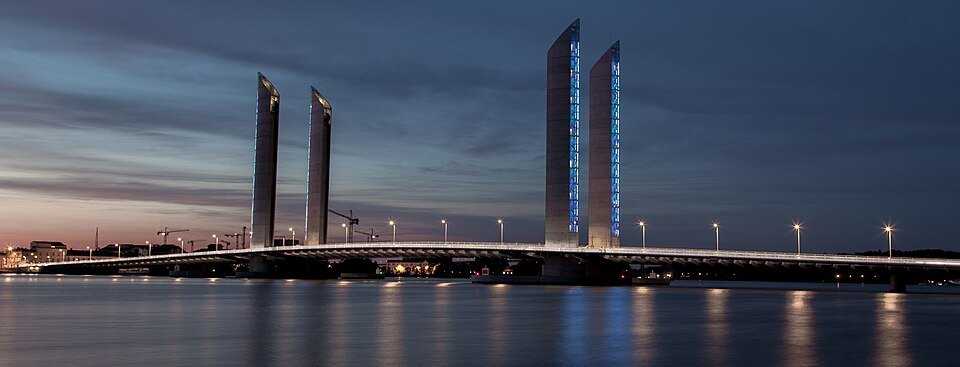
The Pont Jacques Chaban-Delmas, the lift bridge opened in 2013 at the northern end of the crescent, was designed so that tall ships and cruise ships could still reach the moorings in front of the city: its central span rises between four towers to let them through.
The World Heritage city
In June 2007 UNESCO inscribed Bordeaux, Port of the Moon, on the World Heritage List. The listed area covers about 1,800 hectares, some forty percent of the city: the river, the whole historic front of the quays, more than 350 listed historic monuments and a protected historic core of 150 hectares, with a buffer zone of 3,725 hectares around it. It was then the largest urban area ever inscribed. UNESCO recognized a city of unusual architectural unity, classical and neoclassical, with a royal square and long, regular façades, the legacy of its growth in the eighteenth century, the age of the Enlightenment and of colonial trade.
The listing also rewarded a recent transformation. From 1995 an urban project cleaned the blackened stone façades and lit them at night, brought the tram back and turned the old port quays into a promenade, and the city turned to face its river again. Among the works UNESCO singled out were the restoration of the Place de la Bourse and the quays, and the Miroir d'Eau in front of it.
Where to see the crescent
The curve is hard to grasp from the quay itself, where you are standing on it. Cross the Pont de Pierre to the right bank and walk along the Quai des Queyries in La Bastide, and the whole stone front bends away in front of you, from the spire of Saint-Michel to the Bourse and the Quinconces. From above, the view from the spire of Saint-Michel or from the belvedere of the Cité du Vin shows the bend of the river around the city.
The best moment is the evening, when the façades are lit and the Place de la Bourse stands in the water of the Miroir d'Eau. The quays page linked at the start of this article lays out the walk reach by reach; for the ways across the river, see getting around.
More from the journal
- The Bassins à Flot and the Submarine BaseWhat is inside the old submarine base in Bordeaux?A wartime U-boat bunker on the Bassins à Flot, now a digital art center in its flooded pens and a neighborhood arts venue. What it was, what you see inside, and what grows on its roof.Read the piece
- The Pey-Berland TowerWhich tower should you climb in Bordeaux, Pey-Berland or Saint-Michel?Bordeaux has two great free-standing bell towers: the cathedral's Pey-Berland Tower in the middle of the old town and the spire of Saint-Michel by the river. How they differ, what you see from each, and what to check first.Read the piece
- Eating & DrinkingWhat is a canelé, and where does it really come from?The fluted, caramel-crusted cake you will see in every Bordeaux bakery window: what goes into it, how it is baked, the convent legend, the guild of canauliers, and why its name lost an n in 1985.Read the piece