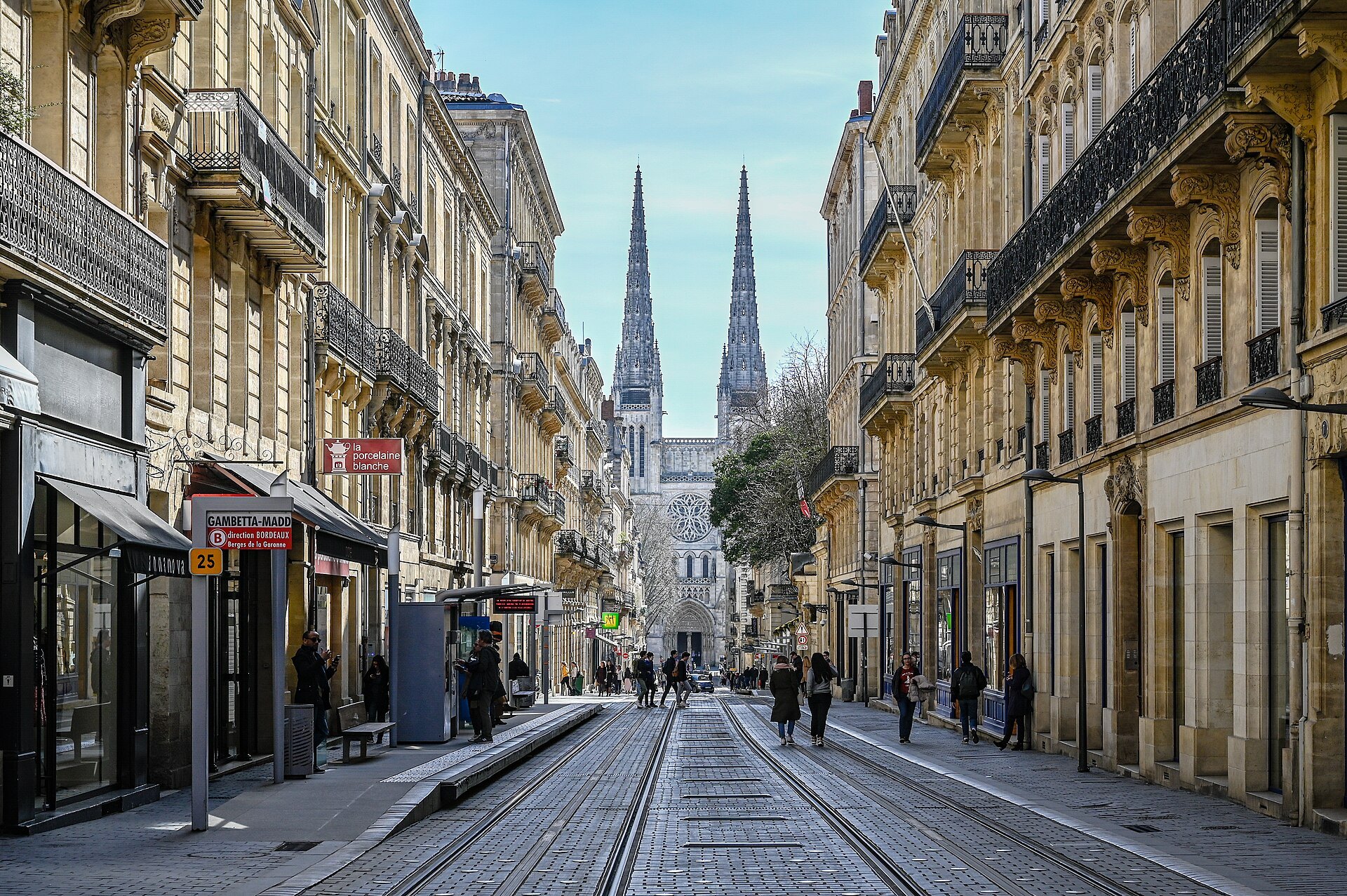
Which tower should you climb in Bordeaux, Pey-Berland or Saint-Michel?
Bordeaux has two great free-standing bell towers: the cathedral's Pey-Berland Tower in the middle of the old town and the spire of Saint-Michel by the river. How they differ, what you see from each, and what to check first.
Read on
The short answer
For most visitors, the Pey-Berland Tower. It is the bell tower of Saint-André Cathedral, it stands in the middle of the old town, and it is run for visitors by the Centre des monuments nationaux, the state body that looks after it. Its 233 steps climb a narrow spiral staircase to a terrace about fifty meters up, with the cathedral's roofs and spires at your feet and the whole old town spread around you.
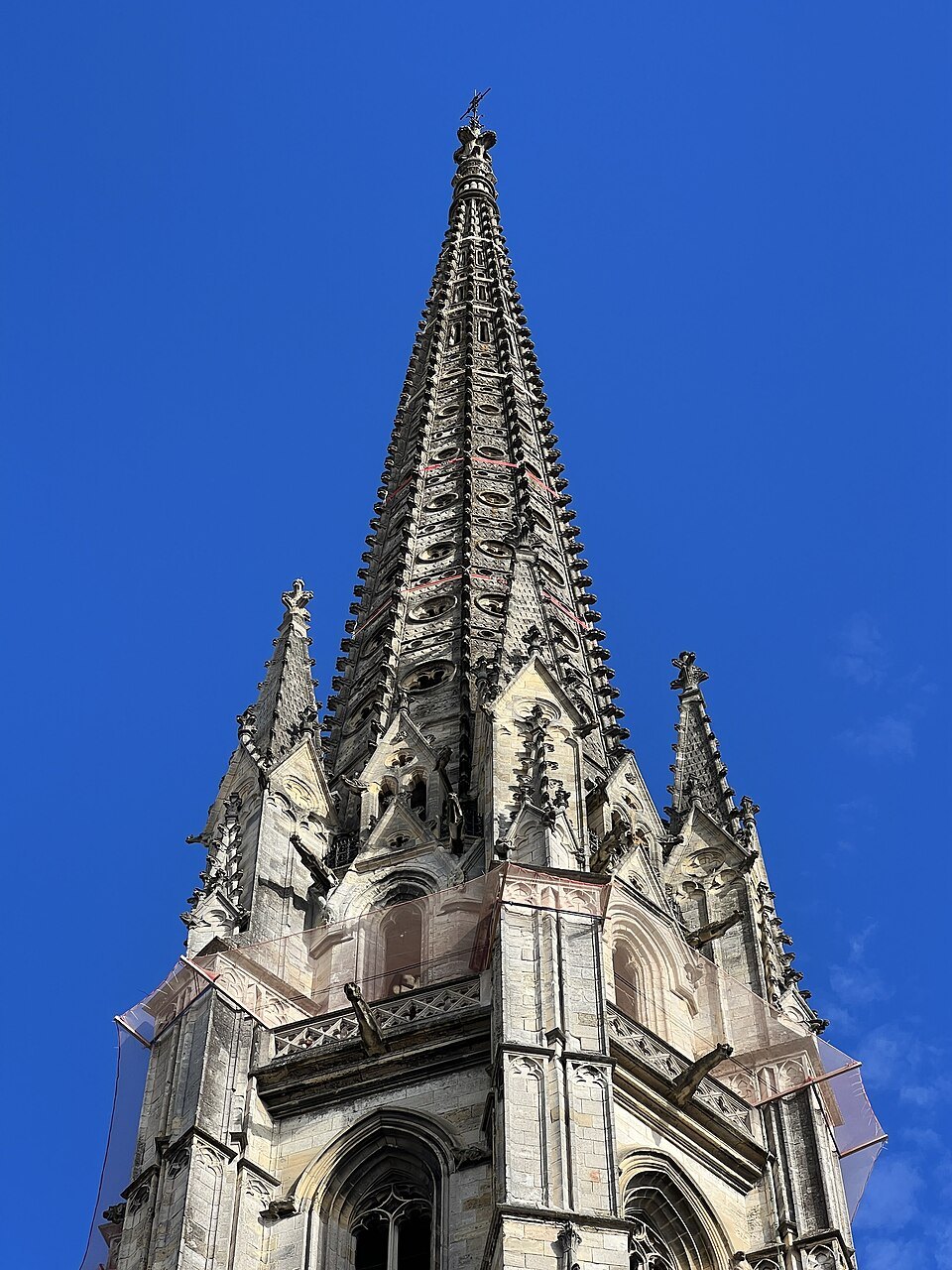
The spire of Saint-Michel is taller, the tallest bell tower in the south of France, and its view takes in the river and the Pont de Pierre. But it has been under restoration since November 2020, in works planned to last about five years, so check whether it can be visited before you plan around it. If you can, and you have the legs for both, climb both: they show two different cities.
Why the towers stand apart from their churches
Both towers stand on their own, some distance from the churches they serve, and that is no accident. The ground under old Bordeaux is soft and marshy, and a separate bell tower keeps the vibrations of the bells from shaking the church. The arrangement is common in the Gironde. The Pey-Berland Tower was once joined to the cathedral by the houses of the canons, as was the custom in western France, but those houses are long gone, and today it stands alone on its square.
Saint-Michel's tower was built about fifteen meters in front of its church, on the site of an old charnel house, between 1472 and 1492, under a master builder from Saintes, Jean Lebas, and his sons. A chronicler recorded that by the end of September 1492 the work had reached such a height that no workmen could be found willing to take the risks of carrying it higher, and two of the master masons finished it themselves.
The Pey-Berland Tower
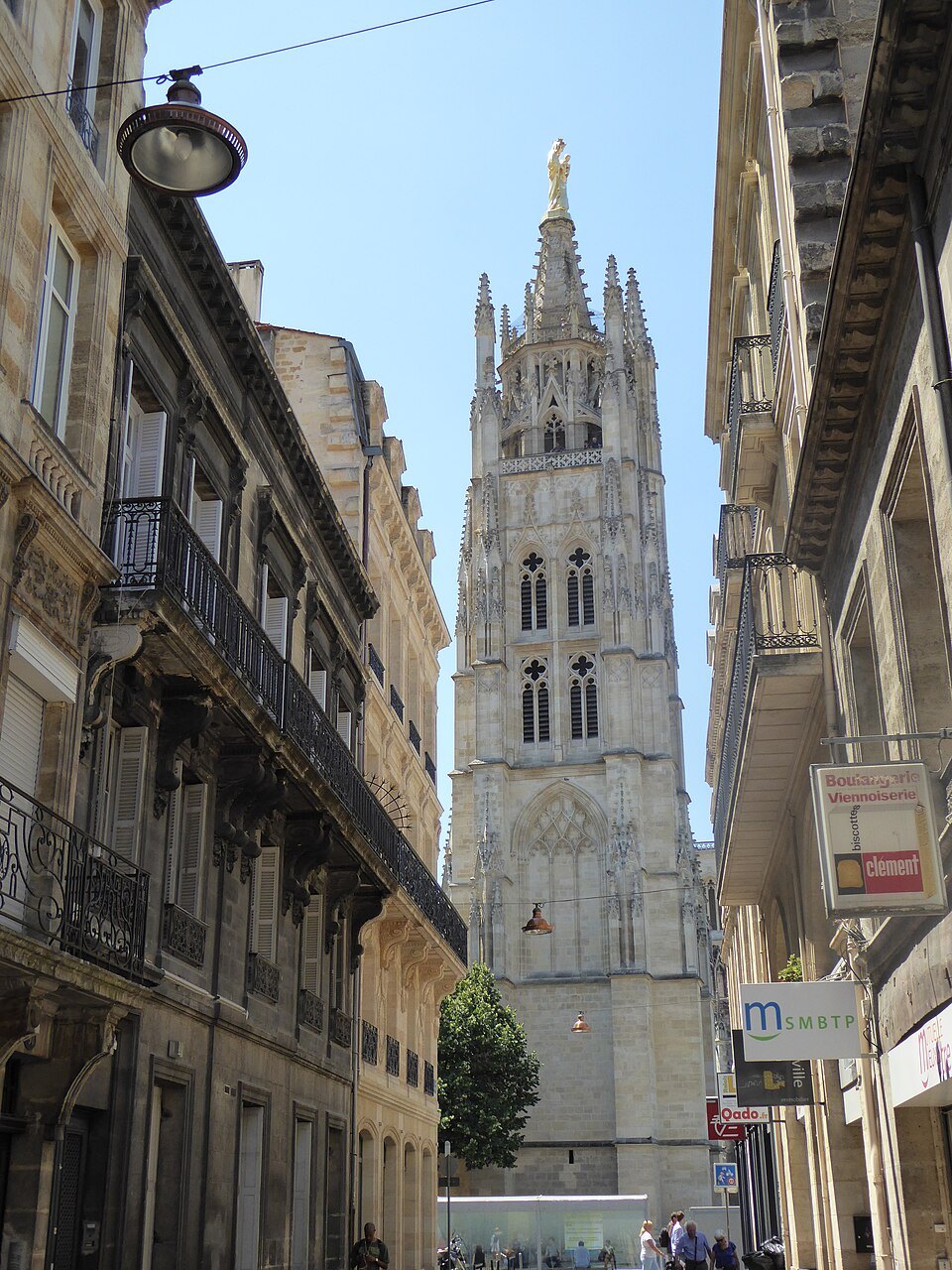
The tower is named after the archbishop Pey Berland, who began it; building ran from 1440 to about 1500. A Latin inscription on its north face records the laying of the first stone by the archbishop in October 1440 and asks the passer-by to look kindly on a tower that is, in its own curious word, not square. During the Revolution it was sold off as national property and turned into a factory for lead shot and a store for fodder; it became a religious building again by decree in 1851.
Its spire was cut short by a storm with hurricane-force winds in the eighteenth century. Since 1863 it has been crowned by a gilded statue of the Virgin and Child, Notre-Dame d'Aquitaine, by Jean-Alexandre Chertier, six meters tall, its base about sixty meters above the ground. The statue faces the Médoc village of Saint-Raphaël in Avensan, where Pey Berland was born. Inside hangs a great bell, a bourdon of more than eight tonnes.
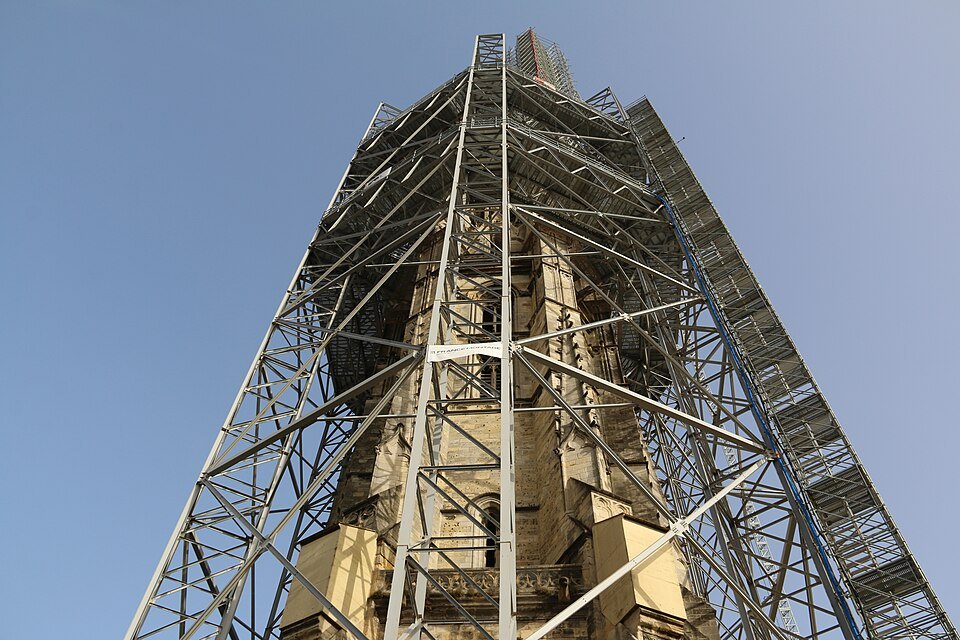
The climb is the point. The 233 steps wind up a tight stone spiral to the terrace, a gallery that runs round the base of the spire about fifty meters above the square. From there you look down onto the flying buttresses and roofs of the cathedral, across to the Palais Rohan and the town hall, and out over the tiled roofs of the old town to the river. The staircase is narrow and steep, so it does not suit anyone uneasy in tight spaces or at height.
The spire of Saint-Michel
At 114 meters, the Saint-Michel spire is the tallest bell tower in the south of France and the fourth tallest in the country, after the cathedral spires of Rouen, Strasbourg and Chartres. It has had a rough history. After Bordeaux rang the alarm from it during a revolt against new taxes in 1675, Louis XIV ordered it destroyed in 1676, and only Vauban, who called it one of the finest pieces in Europe, talked him out of it. An earthquake damaged it in 1759, lightning struck it repeatedly, and in 1768 a hurricane carried the spire away.
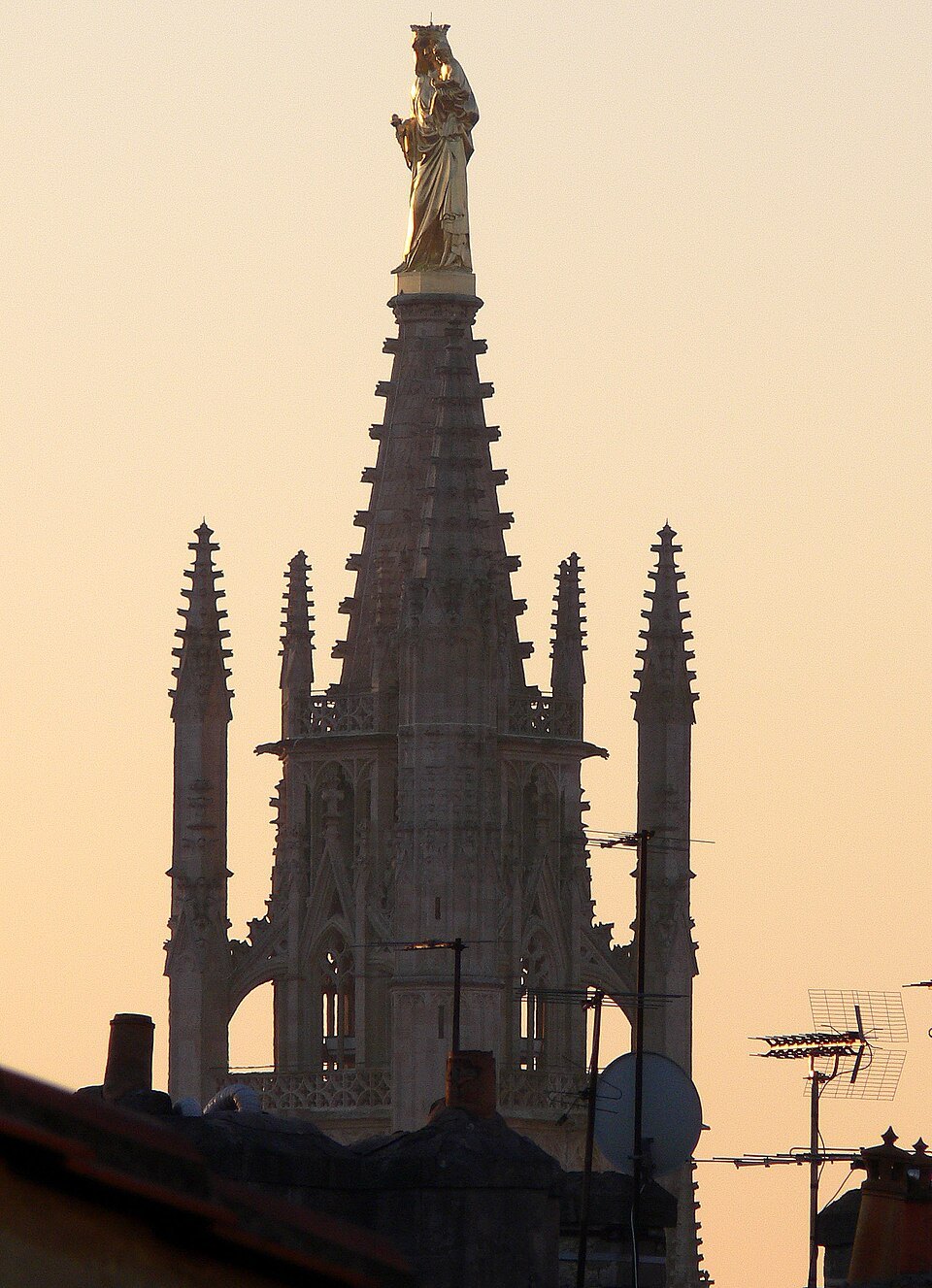
For almost a century it stood truncated. From 1822 to 1851 it carried a Chappe telegraph, and Victor Hugo, passing through in 1843, described it as no longer a bell tower but the skeleton of one. The spire you see today is a reconstruction, built between 1861 and 1869 by Paul Abadie, the architect who later designed the Sacré-Cœur in Paris. German bombs in June 1940, when the French government had taken refuge in Bordeaux, shattered windows and pitted the façade and the spire, and the marks can still be seen.
The crypt at the foot of the tower was long famous for its mummies, some sixty bodies found preserved in the clay soil when the old parish cemetery was cleared in 1791 and set out in a circle for visitors; Victor Hugo and Théophile Gautier both came to see them. The crypt was closed to the public in 1979 and the bodies were reburied in the Chartreuse cemetery in 1990.
What you see from each
The two views complement each other. From Pey-Berland you are in the heart of the old city: the cathedral directly below, the grid of the eighteenth-century city to the north and west, and the medieval streets running down to the quays. From Saint-Michel, by the river at the southern end of the crescent, the view runs along the Garonne, over the arches of the Pont de Pierre and across to the right bank, and back over the roofs of the old town; it is the view that opens this site's homepage.
If neither tower is possible on the day, the belvedere on the eighth floor of the Cité du Vin, at the northern end of the quays, gives a high view over the river and the lift bridge, and it comes with the museum ticket.
Planning the climb
Visits to Pey-Berland are run by the Centre des monuments nationaux, which sets the visiting times and sells the tickets, and in the busy season it is worth arranging ahead; see booking ahead. Go on a clear day and avoid the middle of a hot summer afternoon, when the stone stairs are close and the terrace is exposed. Wear shoes with a good grip, and leave large bags behind.
Pey-Berland combines naturally with Saint-André Cathedral, the Palais Rohan and the Musée d'Aquitaine, all a few minutes away. Saint-Michel sits in a lively quarter with a flea market on its square; from there the quays lead north to the Porte Cailhau and the Place de la Bourse.
More from the journal
- The Port of the MoonWhy is Bordeaux called the Port of the Moon?The name comes from the crescent-shaped bend of the Garonne, and it runs from the medieval arms of the city to its modern logo and its UNESCO listing. Here is where to see the curve, and why the river is the color of caramel.Read the piece
- The Bassins à Flot and the Submarine BaseWhat is inside the old submarine base in Bordeaux?A wartime U-boat bunker on the Bassins à Flot, now a digital art center in its flooded pens and a neighborhood arts venue. What it was, what you see inside, and what grows on its roof.Read the piece
- Eating & DrinkingWhat is a canelé, and where does it really come from?The fluted, caramel-crusted cake you will see in every Bordeaux bakery window: what goes into it, how it is baked, the convent legend, the guild of canauliers, and why its name lost an n in 1985.Read the piece