What is the story of the Grosse Cloche, the bell gate of Bordeaux?
The story of the Grosse Cloche, Bordeaux's bell gate: a medieval wall tower turned civic belfry, and how to see it today.
Read on
A gate that became a symbol
Bordeaux kept very few buildings from the Middle Ages, and the Grosse Cloche is one of only two gates that survive, along with Porte Cailhau. It has become the symbol of the city in a way no church has, and the gate with its bell still appears on the arms of Bordeaux.
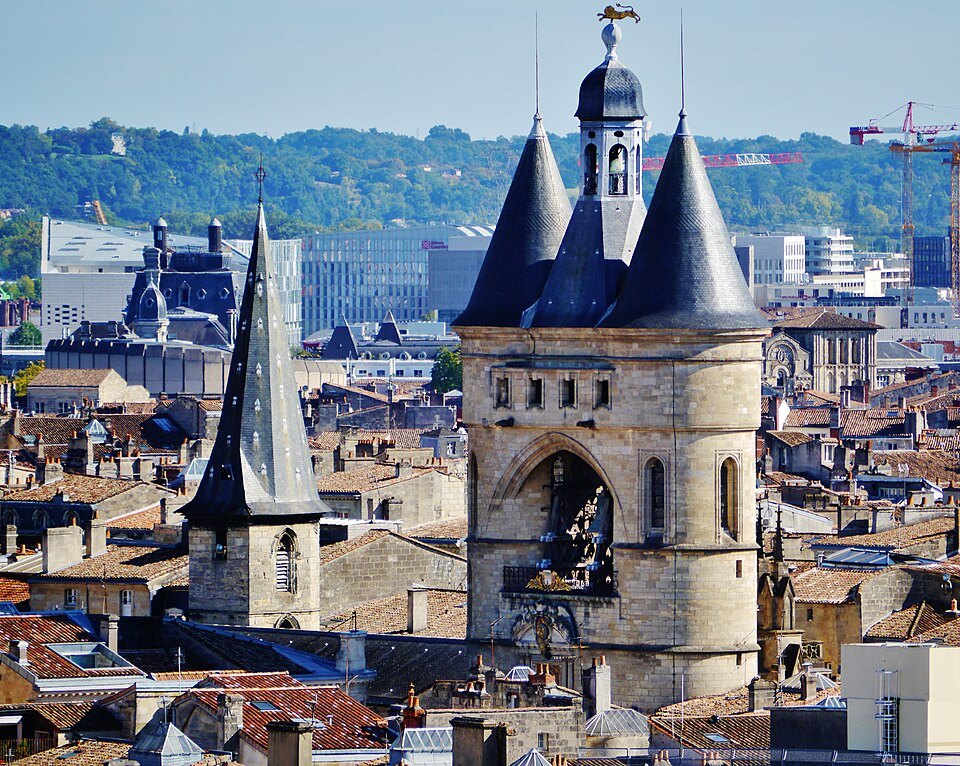
The nickname comes from the bell inside it, the big bell. The building carries other names as well. It is the Porte Saint-Éloi, after the church once built against it, and the Porte Saint-James, because it stood on the pilgrim road to Santiago de Compostela. The rue Saint-James, which runs through the arch, takes its name from the Gascon form of Saint James, and pilgrims once walked under the gate on their way south.
From city wall to belfry
The first gate on this spot was part of the thirteenth-century town wall, built against the twelfth-century church of Saint-Éloi. The building seen today went up in the fifteenth century on the remains of that earlier gate, and over the following two centuries it was altered so often that it stopped being simply a gate and became a belfry. The town's bell was hung in the fifteenth century, and the gate took on a new role as the bell tower of the old town hall, which stood alongside it.
Magistrates rang the bell to mark the start of the grape harvest and to raise the alarm at the outbreak of fire, and the people of Bordeaux grew attached to the sound. Kings took notice too. When the city rose against royal authority in the 1548 revolt remembered as the jacquerie des Pitauds, Henry II had the bell taken down and broken as punishment for the insubordination. It was restored in 1561, to general relief in the city.
The gate originally had four round, crenellated towers of a single storey; two more were later added, standing where the middle of the cours Victor-Hugo now runs, on what was then the ditch along the wall. A fire in 1755 led to the towers being crowned with battlements, a bell turret and the pointed roofs that give the building its present, almost fairy-tale outline.
What the visitor sees
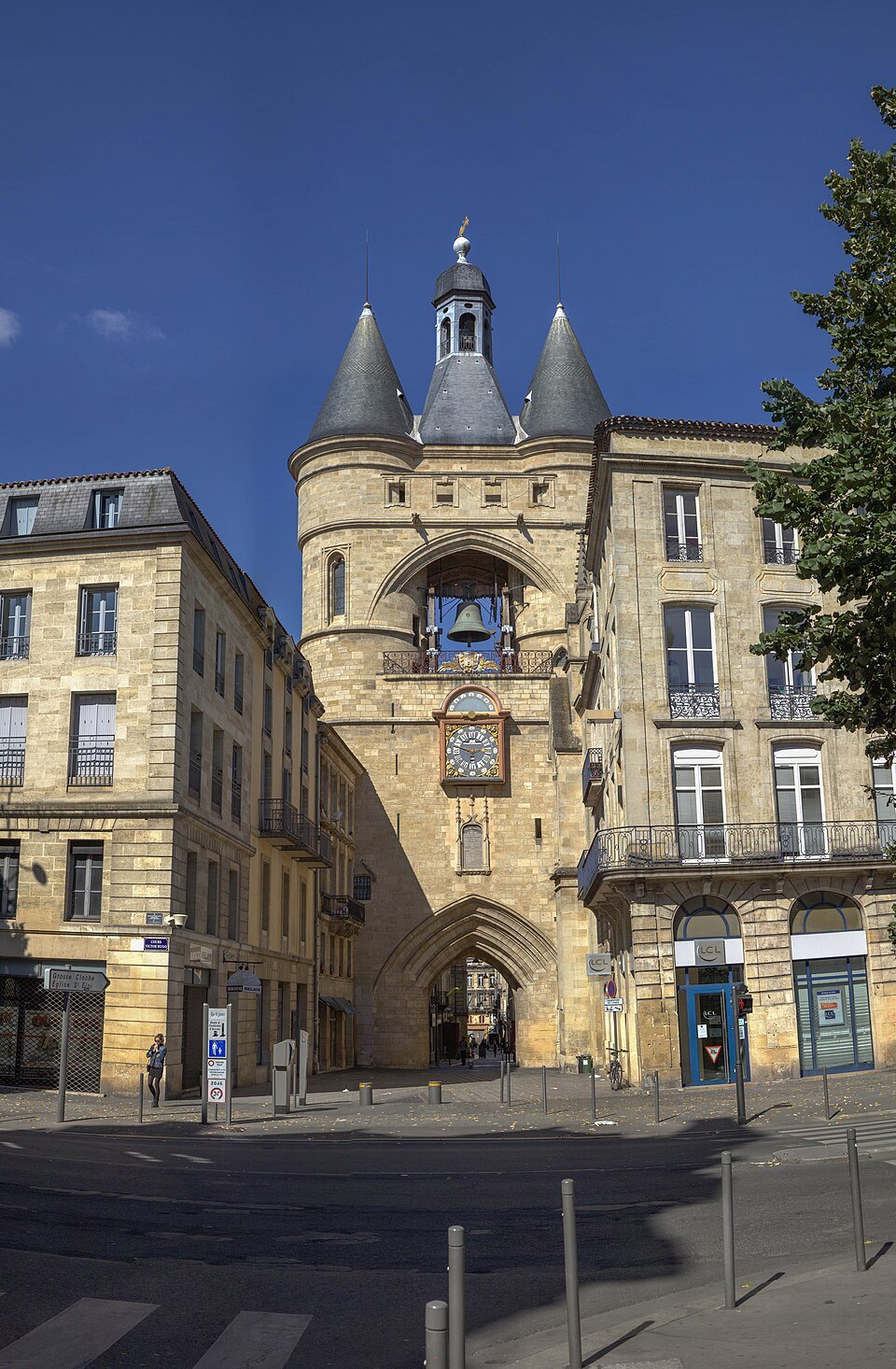
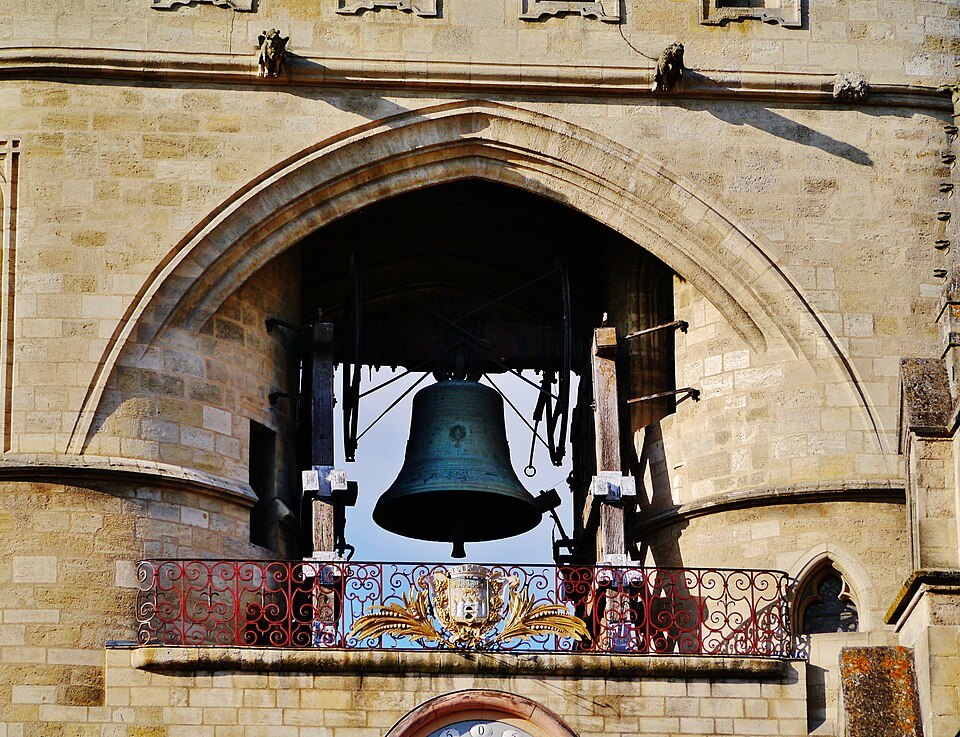
Approaching from the rue Saint-James, the gate fills the end of the street: two round towers rising forty meters, linked by a central block, with the bell visible in an open bay behind an eighteenth-century wrought-iron grille. The city's coat of arms sits at the center of that grille.
Above the bell is the clock, built in 1759 to a design by the mathematician and astronomer Paul Larroque, replacing an earlier clock of 1567; above that is a sundial. On top of the whole structure, the weathervane takes the form of a golden leopard, the beast on the arms of English Guyenne, a reminder that Bordeaux was capital of the English duchy for three centuries. Walking through to the north side and looking up reveals fifteenth-century gargoyles, with marble inscriptions beneath them dated 1592.
The bell itself
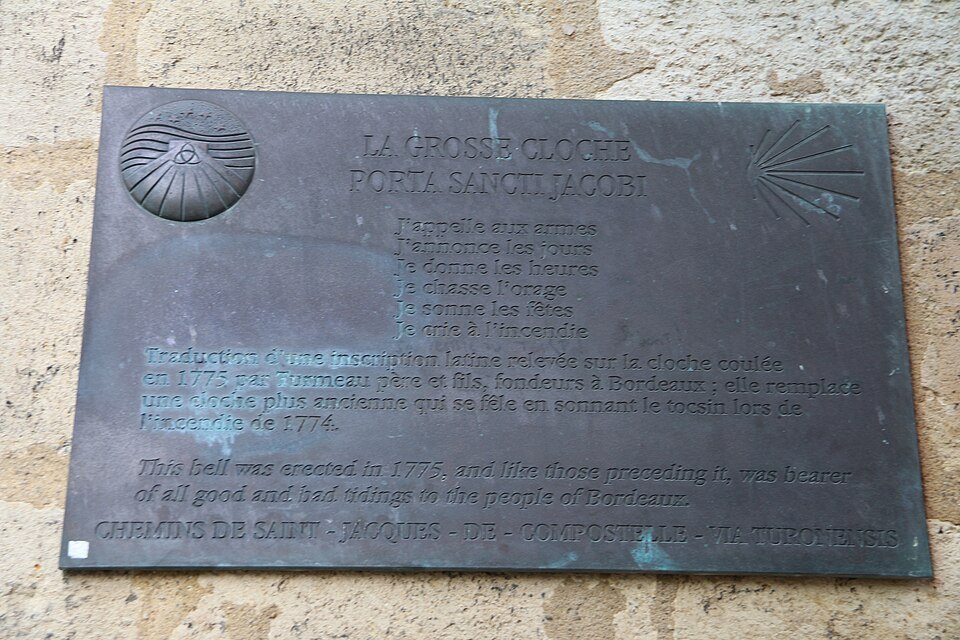
The bell was cast in June 1775 by the founder Turmeau, a fact recorded on a plaque under the tower. It weighs seven thousand eight hundred kilograms and measures two meters in both height and diameter, a scale that explains why its sound carries so far across the old town.
It is inscribed with its own job description, six lines in French that amount to: it calls to arms, announces the days, gives the hours, chases away the storm, rings for festivals, and cries out at fire. Few bells anywhere state their purpose so plainly.
When it rings
Because of its weight and the risk that its own vibration could crack it, the bell has been rung only sparingly over the centuries. It rang for the victory of 8 May 1945 and for General de Gaulle's visit on 10 April 1961. For years it sounded on five days a year: the national and memorial holidays and the anniversary of the liberation of Bordeaux on 28 August 1944. Since 2016 it has also rung on the first Sunday of each month.
Anyone in the old town on one of those days will notice the crowd gathering in the street below, which is part of the occasion. The tower itself can be visited in summer, but the city sets the exact dates and times each year; check with the tourist office or the city's own listings before planning a visit around it.
How to visit
The gate stands where the rue Saint-James meets the cours Victor-Hugo, on the Saint-Pierre and Saint-Michel side of the old town. Seeing it from the street takes no more than ten minutes and a walk through the arch in both directions. The rue Saint-James itself rewards a slow walk: this is the pilgrims' street, running from the gate toward the heart of the old town, and the arch frames the view along it from either end. Standing back on the cours Victor-Hugo side gives the clearest view of the towers against the sky.
The gate sits neatly on a walk between the cathedral and the basilica of Saint-Michel, with the Musée d'Aquitaine a few minutes away along the cours Pasteur. It fits naturally into a first day's route through the old town; see the itineraries for how it connects with the rest of the walk.
A word of caution on names: Grosse Cloche refers to the whole building, not only the bell, though locals use the name for both. The pointed roofline looks medieval but in fact dates from after the 1755 fire, and the building was last restored in 2016. The leopard on the weathervane is sometimes mistaken for a lion; in heraldry it is the English leopard, the same creature found on the arms of the English kings, which is precisely why it stands here.
More from the journal
- The Pey-Berland TowerWhich tower should you climb in Bordeaux, Pey-Berland or Saint-Michel?Bordeaux has two great free-standing bell towers: the cathedral's Pey-Berland Tower in the middle of the old town and the spire of Saint-Michel by the river. How they differ, what you see from each, and what to check first.Read the piece
- Where to StayWhich area of Bordeaux is best for a first visit?A guide to Bordeaux's districts, from the lively old town to quieter riverside and residential quarters, for first-time visitors.Read the piece