Why does the Place de la Bourse face the river?
How Bordeaux broke a wall to open its grandest square onto the Garonne, and what that opening started.
Read on
Facing the water, not the city
The question answers itself once you know what used to stand here. Before the Place de la Bourse existed, the city met the Garonne with a wall, a working port hidden behind fortifications. The square was built open on one side rather than enclosed, the first time that had been done in the history of French town planning, and the side left open was the river.
A stretch of that wall was pulled down to make way for it, and the rest of the eighteenth-century quays followed the same logic once the square had shown what a riverfront could look like. The square was never meant to be admired only from inside the city. It was built to be the face the city showed to anyone arriving by water.
A wall becomes a balcony
The idea belonged to Claude Boucher, the royal intendant appointed by Louis XV in 1720. He wanted a modern city that presented a handsome front to visitors arriving by the right bank, where the river bends and the whole quay comes into view at once. To clear the ground, twenty-one houses and ten small shops were demolished, and about 150 meters of the old walls were taken down.
In their place went a terrace built out on pine piles, roughly 150 meters long, turning the riverfront into a kind of balcony over a port where hundreds of ships lay at anchor. That terrace is the reason the square can face the water at all: the ground it stands on was built outward from the old wall line, toward the river rather than away from it.
The Gabriels and the opening
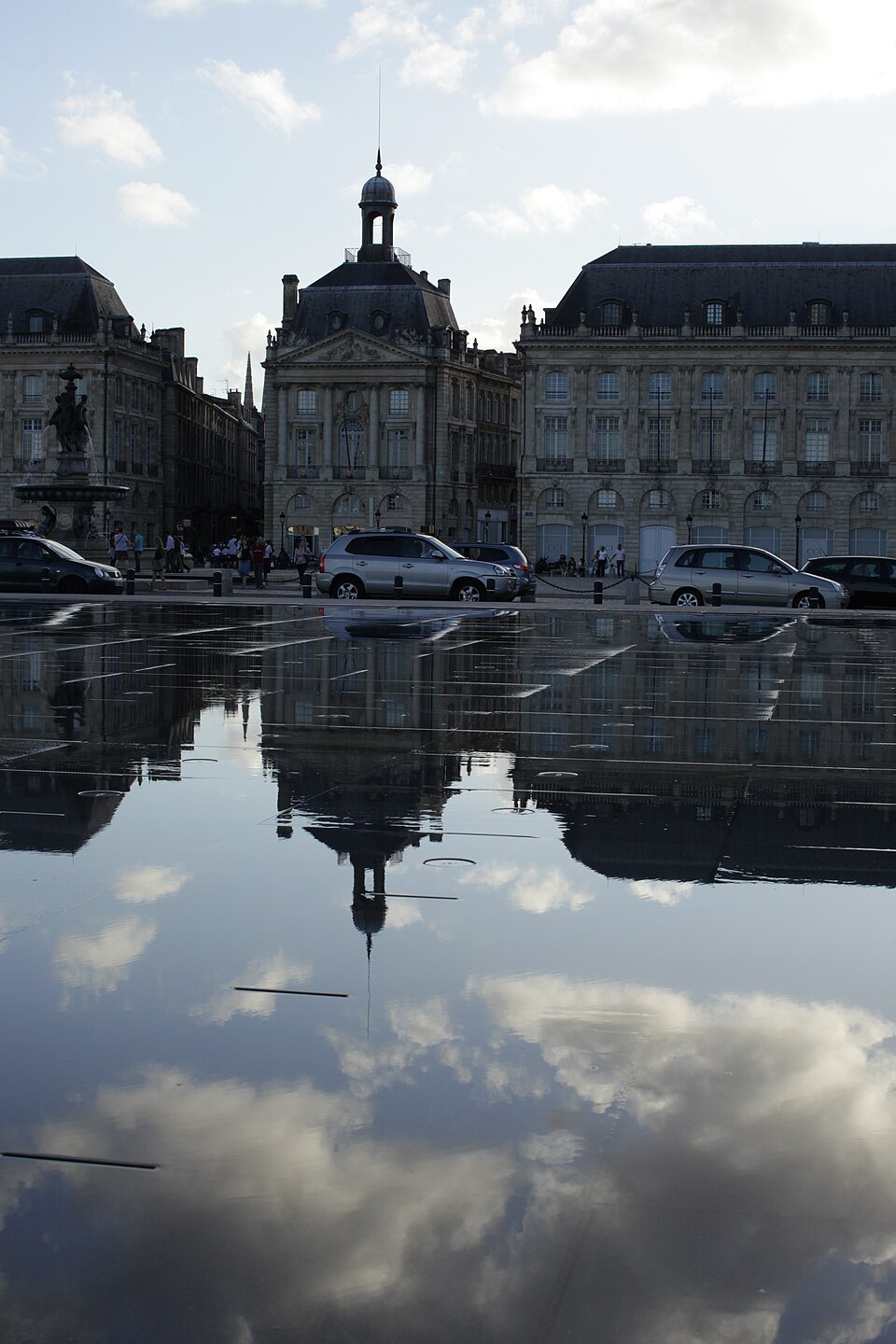
The king's architect Jacques Gabriel drew the facades, and he appears to have had the Place Vendôme in Paris in mind, a square designed by his cousin and teacher Jules Hardouin-Mansart. A bronze equestrian statue of Louis XV by Jean-Baptiste Lemoyne was unveiled at the center on 19 August 1743. After Jacques Gabriel died in 1742, his son Ange-Jacques took over, finishing the Palais de la Bourse on the north side in 1749.
The narrow central pavilion, built by André Portier, was completed in 1755, the year the square was formally inaugurated. Its name changed with every regime after that: Place Royale, then Place de la Liberté once the king's statue was pulled down and melted for cannon in 1792, briefly Place Impériale for Napoleon's visit in 1808, Place Royale again in 1815, and the present name from 1848.
What the open side set in motion
The square set the tone for the whole stretch of classical quays known as the Port of the Moon, the crescent that UNESCO inscribed on the World Heritage List in 2007 as an outstanding example of eighteenth-century French architecture. It is listed alongside the rest of that ensemble rather than as a separate monument, because the quays that followed it kept faith with the same idea: a classical front built to be read from the water.
That is also why it works as a starting point for a first walk through the city. Everything that follows along the river, upstream or down, extends the same gesture the square made first.
What you actually see
Stand with your back to the river. On the right, to the north, is the Palais de la Bourse, which still houses the city's chamber of commerce; its clock face is the work of Hustin, a Bordeaux faience maker. On the left is the Hôtel des Douanes, designed by Jacques Gabriel between 1735 and 1738, with sculpture showing Minerva protecting the arts and Mercury favoring trade. Both buildings still do the jobs they were built for.
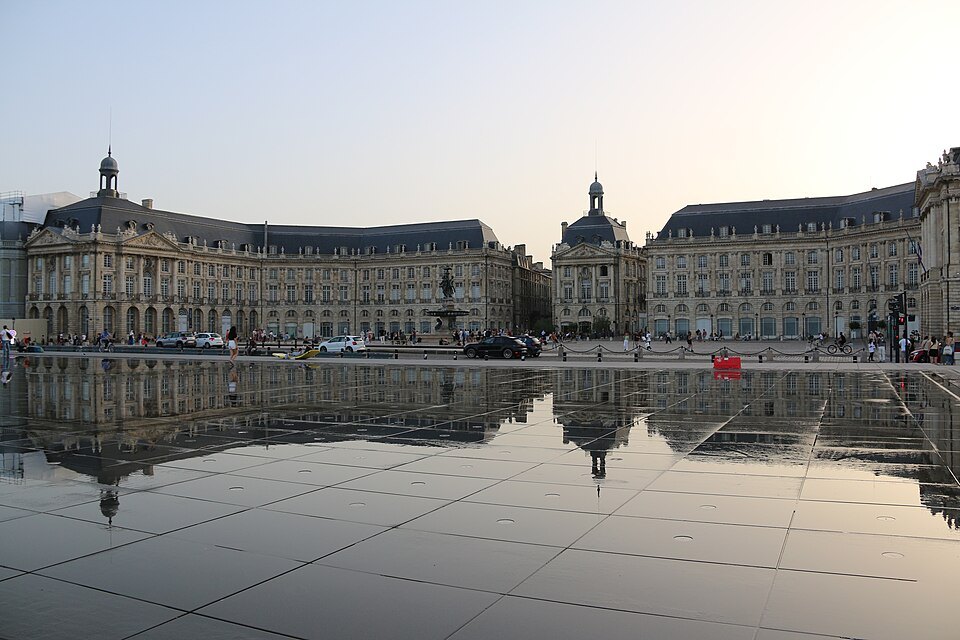
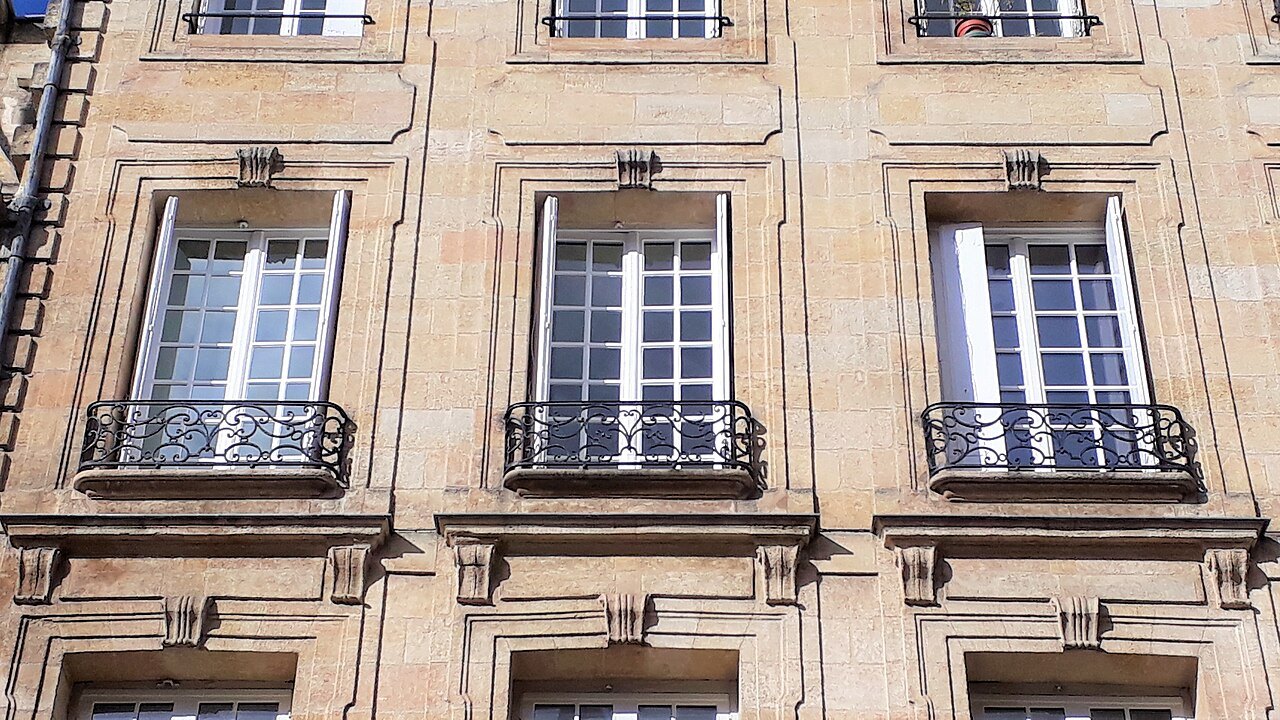
Between them the facades run as a single composed front. The pediments carry allegories carved by Jacques Verbeckt and his colleagues: the grandeur of princes, Neptune opening the seas to trade, the meeting of the Garonne and the Dordogne, and Time revealing Truth. Over the windows are mascarons, the carved faces that are one of Bordeaux's signatures, among them Neptune and Bacchus but also fantastic beasts, carnival masks, angels and big cats.
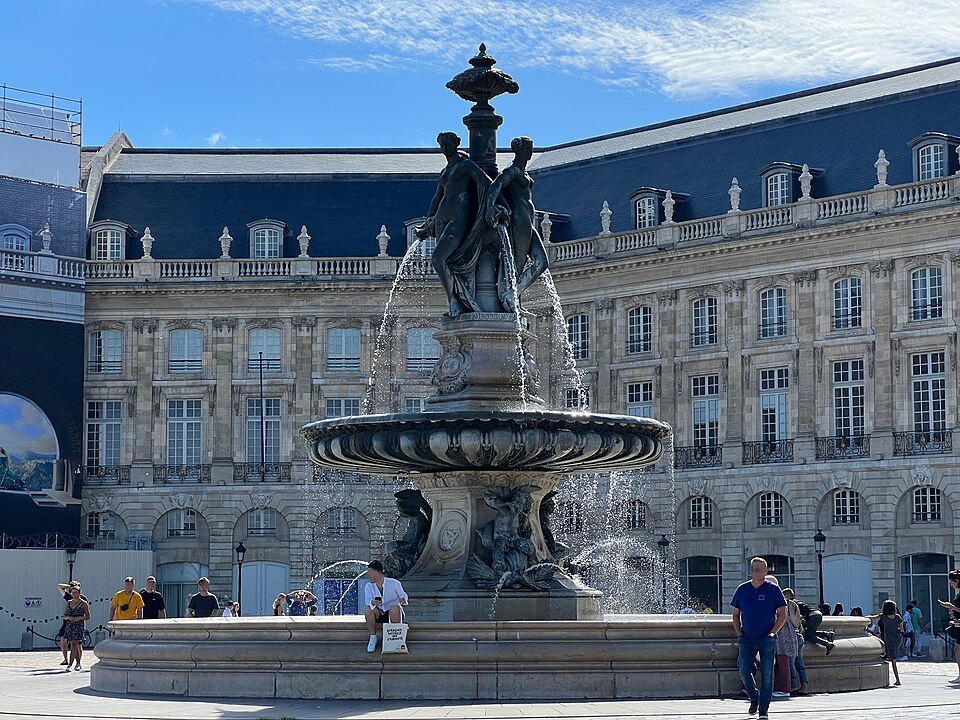
Some of those faces are African women, a reminder in stone that the wealth behind this square came partly from the Atlantic slave trade and the colonial commerce of the eighteenth century. The Musée d'Aquitaine tells that part of the story in full. At the center stands the fountain of the Three Graces, Aglaia, Euphrosyne and Thalia, designed by Louis Visconti, sculpted by Charles Gumery and cast by the Thiébaut foundry.
The mirror across the tramlines
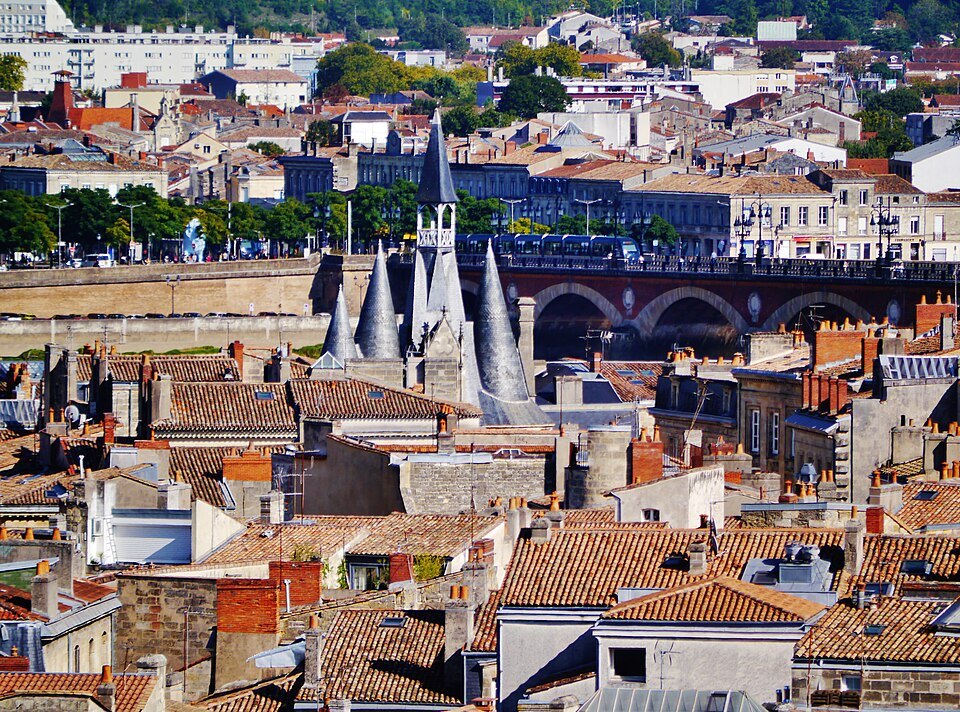
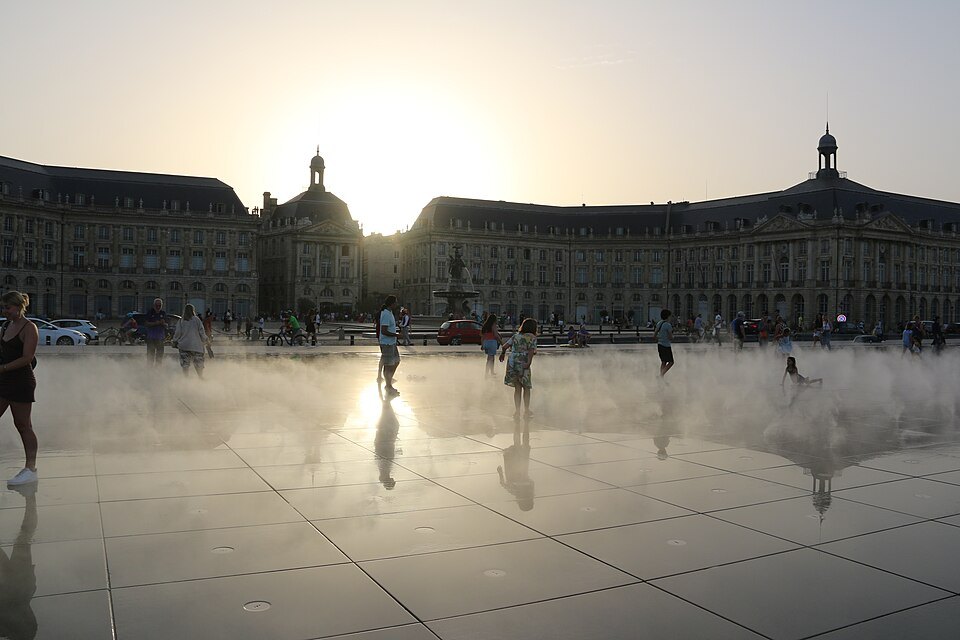
Across the tramlines, on the quay itself, the city built the Miroir d'Eau in 2006 as part of a redesign of the riverfront by the landscape architect Michel Corajoud. A thin film of water covers a granite slab, and when it lies still the whole square appears a second time, upside down. The pool is drained each winter to protect it from frost, so check with the city or a tourist information point before planning a visit around the reflection; see the Miroir d'Eau page for more.
Through much of the twentieth century the square itself served as a car park. A car park was dug beneath it at the start of the twenty-first century instead, and the surface above was paved again from end to end, which is why the whole space now reads as one unbroken sweep from the facades to the water.
Visiting the square
There is nothing to book and no gate: this is a public space, and the best way to see it is to walk its length and then cross to the quay for the full view. Allow half an hour on its own, and ask locally about visiting the customs museum inside the Hôtel des Douanes if that interests you. The light is kindest early and late in the day, when the stone turns gold and, when the water is still, the mirror effect is at its clearest.
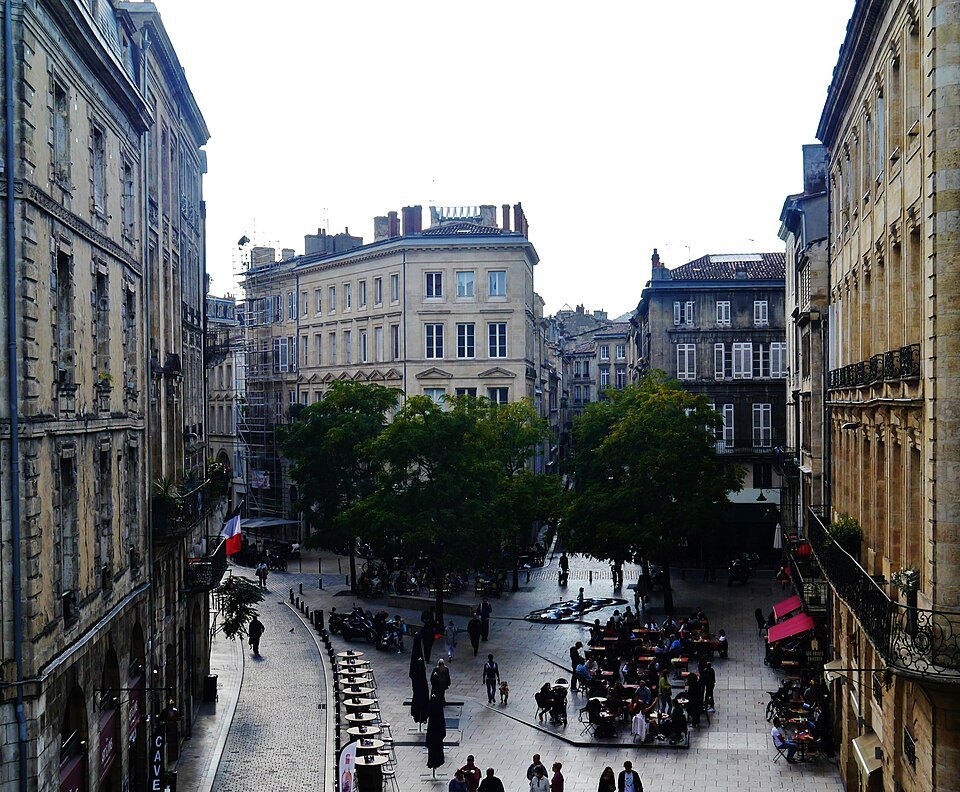
Trams stop in the middle of the square, and the stop was built without shelters or ticket machines so as not to interrupt the view, which is worth knowing while waiting for one. From here the walk continues naturally south to the Porte Cailhau and the Place du Parlement, or north past the Esplanade des Quinconces toward the Chartrons. The square is also the city's traditional starting point for demonstrations and is occasionally given over to events; if it is busy, walk out onto the quay, since the view back across the water is the one worth waiting for.
More from the journal
- The Port of the MoonWhy is Bordeaux called the Port of the Moon?The name comes from the crescent-shaped bend of the Garonne, and it runs from the medieval arms of the city to its modern logo and its UNESCO listing. Here is where to see the curve, and why the river is the color of caramel.Read the piece
- Where to StayWhich area of Bordeaux is best for a first visit?A guide to Bordeaux's districts, from the lively old town to quieter riverside and residential quarters, for first-time visitors.Read the piece
- Getting AroundHow does the Bordeaux tram work for a visitor?A visitor's guide to Bordeaux's tram network: how it works, where to board, and how to pay for a ride.Read the piece