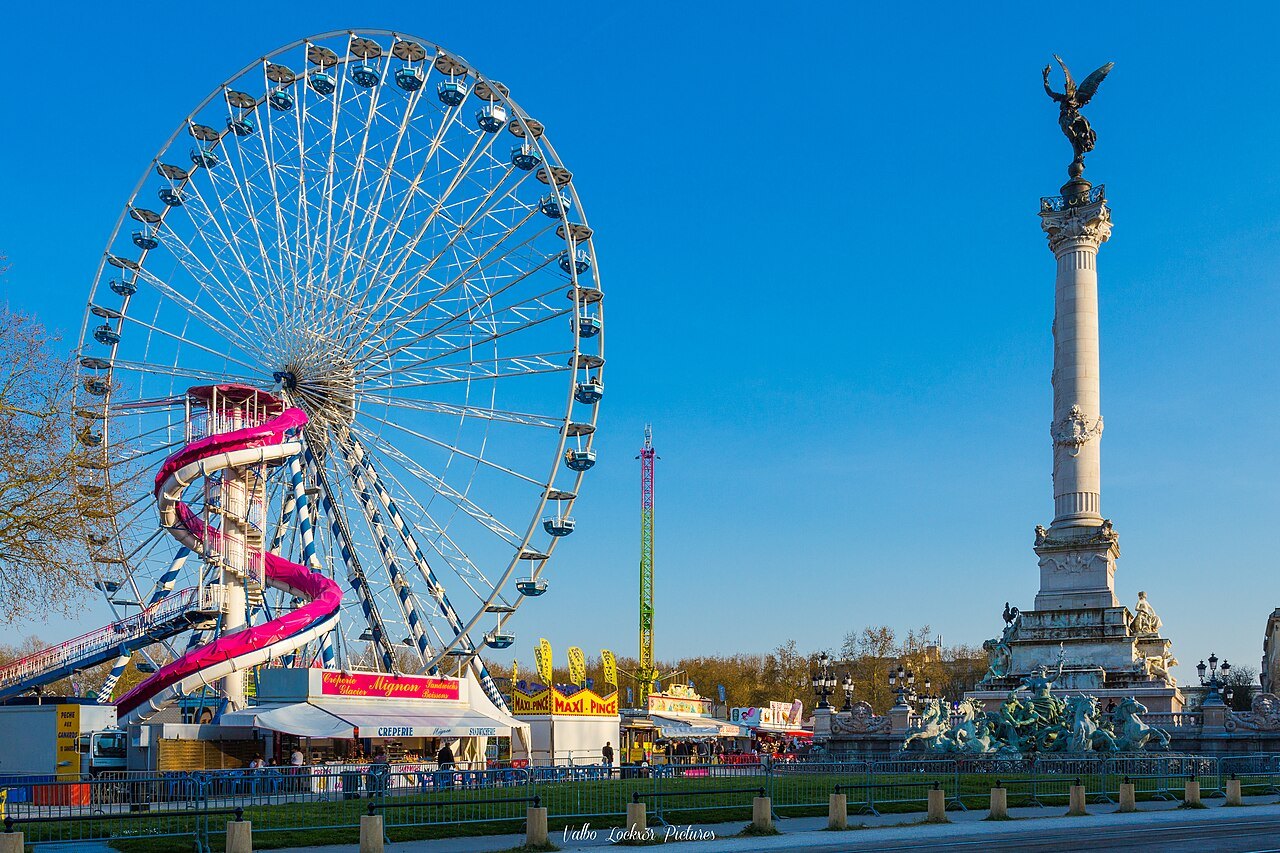
What does the Monument aux Girondins commemorate?
The story behind the tall column at the Quinconces, the Girondin deputies it honors, and its empty niches.
Read on
Who the Girondins were
The column that dominates the Quinconces honors the Girondins, the deputies of the Revolution who came from the Gironde and their political allies in the National Convention. They were a moderate faction, associated with free trade and a looser federal vision of the Republic, and when the Terror turned against the Convention's rivals many of them were sent to the guillotine. Their fall was swift, and for decades afterward their memory was a matter of politics rather than consensus.
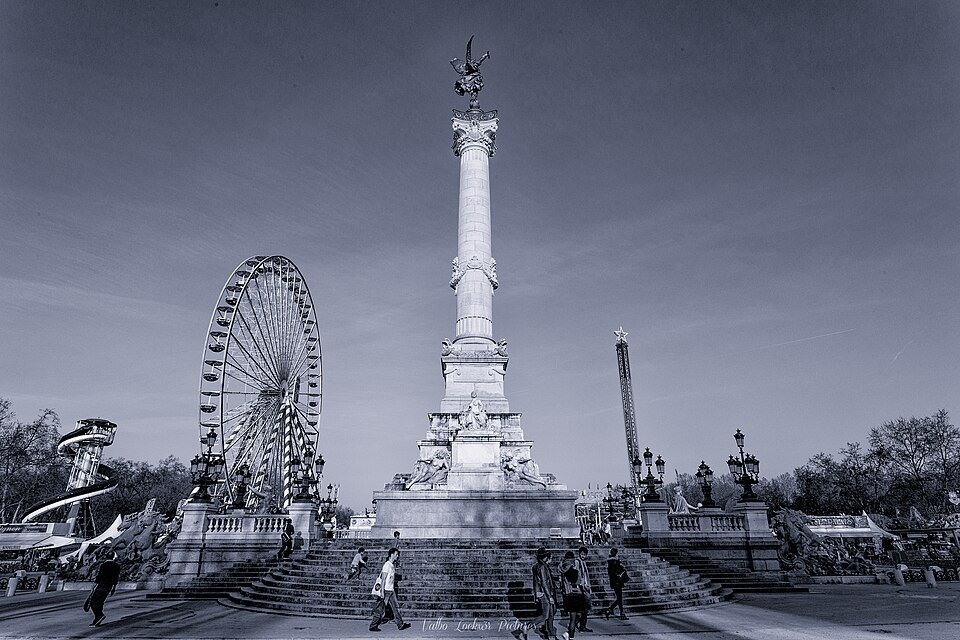
Bordeaux voted to raise a monument to them only in 1881, nearly a century after their deaths, at a moment when the young Third Republic wanted to claim the Revolution's history for itself and when the city wanted a prominent place in that national memory. The choice of site was obvious: the vast open ground of the Quinconces, cleared decades earlier where a royal fortress had once stood, gave the monument room to be seen from a long way off.
From two projects to one
The commission did not go smoothly. A design was chosen in the competition but then set aside in favor of one by the sculptor Alphonse Dumilatre and the architect Victor Rich. Around the same time, the city had separately commissioned a monumental fountain from the sculptor Bartholdi, then backed out when the cost looked too high; Lyon bought the fountain instead, and it stands there today rather than in Bordeaux.
Rather than lose the fountain idea altogether, Bordeaux folded the two abandoned schemes into one project. The result is the monument seen today: a single column rising from a wide base that incorporates two fountains, one on each side. Construction began in 1894 behind a wooden scaffold that was itself fifty-four meters high, taller than the finished monument would eventually be, and the work went on for the better part of a decade, finishing in 1902.
The column and its figures
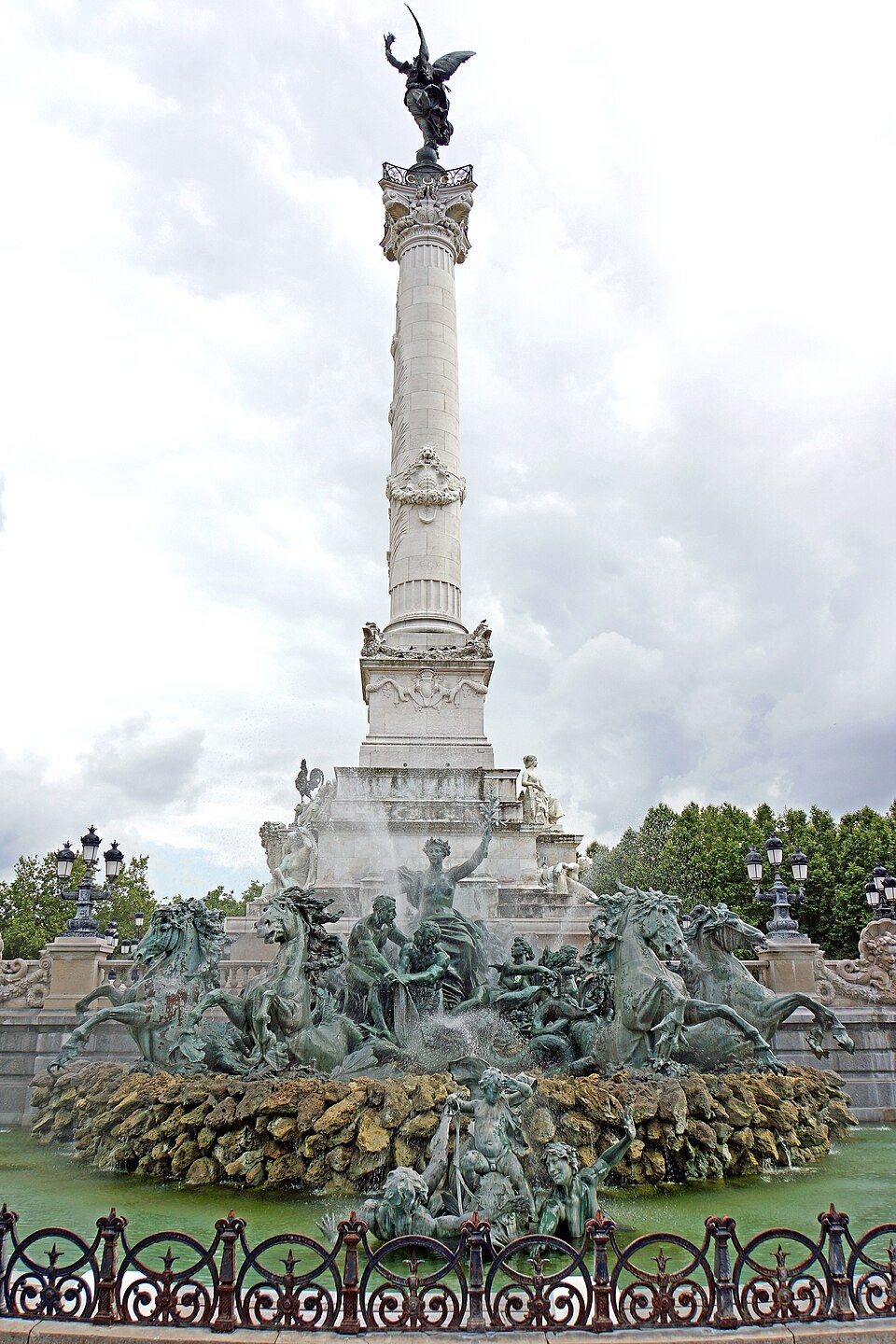
The column itself stands forty-three meters tall, and at the full height of fifty-four meters a green bronze figure called the Spirit of Liberty breaks its chains at the top, visible from well down the esplanade and from the quays. The two fountains built into the base face in different directions and tell different stories rather than repeating the same theme. The one looking toward the Grand Théâtre shows the Triumph of the Republic, a chariot drawn by sea horses trampling figures representing Ignorance, Falsehood, and Vice underfoot; the one facing the Chartrons quarter shows the Triumph of Concord instead, a gentler companion piece.
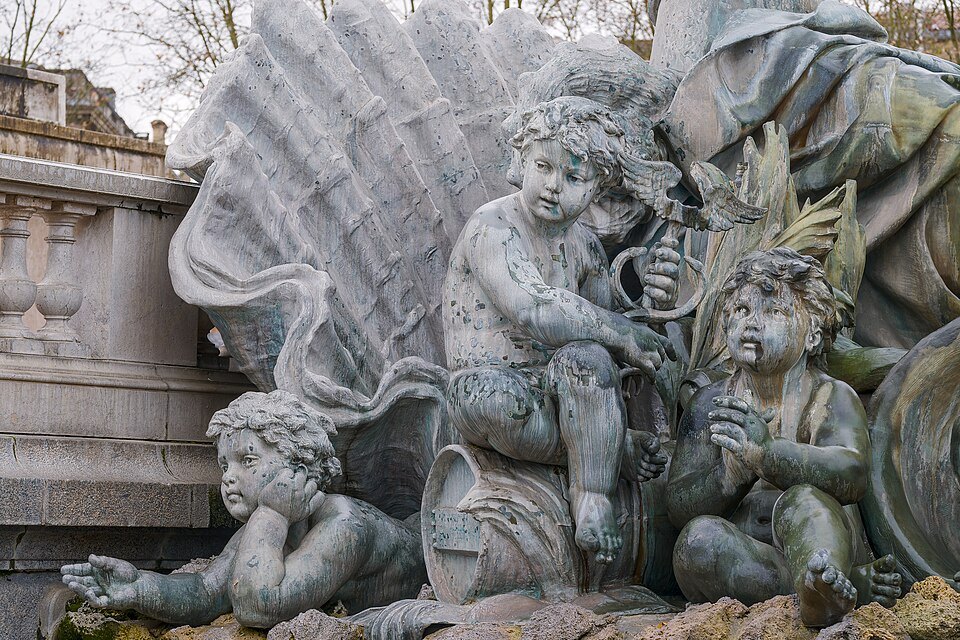
The sides toward the river and toward the city carry their own groups again. Toward the Garonne, a Gallic cockerel stands on a speaker's rostrum flanked by figures representing History and Eloquence, a reminder that the Girondins were above all orators. Toward the city, a personification of Bordeaux sits on the prow of a ship holding a horn of plenty, with figures of the Dordogne and the Garonne rivers beside her, a nod to the two rivers that meet to form the Gironde estuary downstream. The whole base rewards a slow walk around it rather than a single glance from the front, since no one face shows the full program.
What is missing
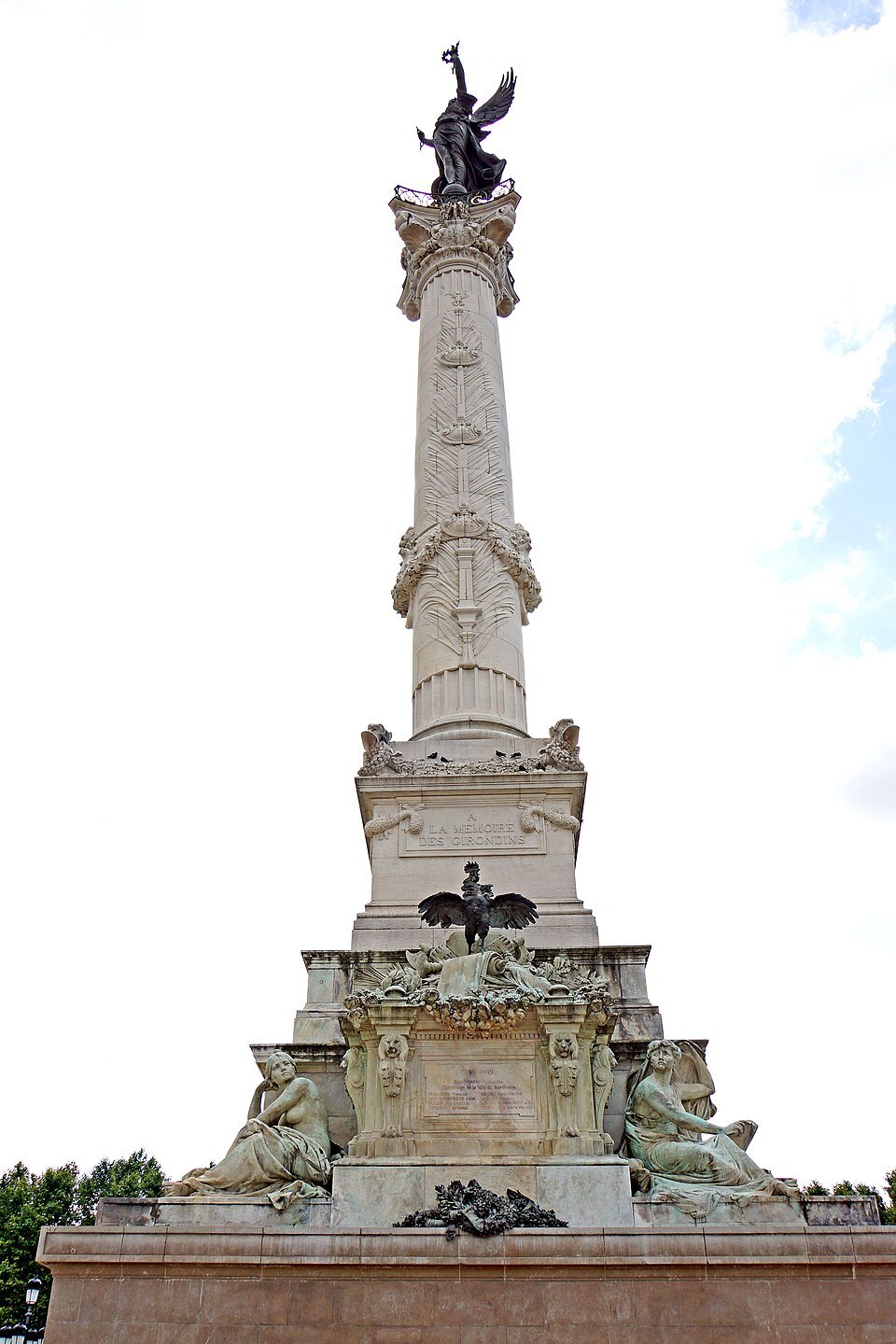
Look closely at the base and the gaps are as telling as the figures that are there. Groups of statues representing eight named Girondin deputies were planned from the very start of the project and never made, whether for cost, time, or changing taste; their intended places on the base are still empty, a permanent sketch of a program that was never finished. A visitor who knows to look for them will notice the bare stone where sculpture was meant to stand.
The bronzes that were made had their own disruption decades later. The occupying army removed them in August 1943 to be melted down for metal, a fate shared by many bronze monuments across occupied France at the time. The foundry in Angers that received them kept them intact instead of melting them, and they were returned after the war, in 1945. They then spent years sitting in port warehouses before finally being reinstalled on the monument in 1983, nearly forty years after they were taken down. A plaque naming eight Girondin deputies was added later still, in 1989, filling in with words what the empty bases on the monument never filled in stone.
Seeing it today
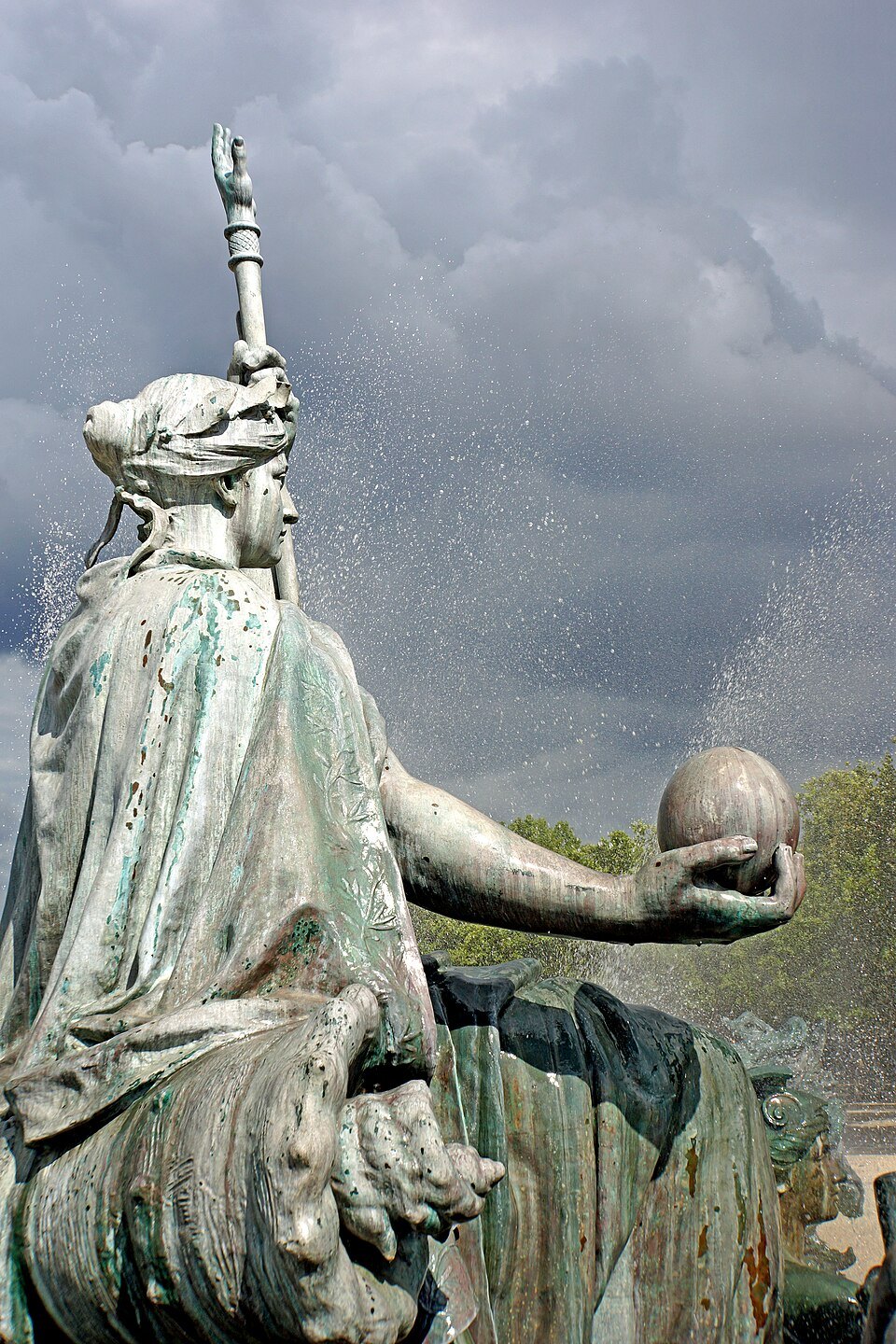
There is nothing to book to see the monument; it stands in the open square and can be approached from any direction. Walking from the column down the long slope to the two rostral columns and the quay takes about ten minutes, and it is worth allowing another twenty minutes to circle the fountains properly, since the figures on each side reward a close look rather than a passing glance from a distance.
The light favors morning and late afternoon for anyone wanting to photograph the bronze figure at the top of the column, when the sun angle picks out the green patina against the sky. For the single best view of the whole composition, walk down to the river end and look back uphill from beside the rostral columns, with the column centered at the top of the long slope and the esplanade's rows of trees framing it on either side. The square's tram stop, where several lines meet, makes a practical starting or finishing point for the visit; see getting around for how the network and its stops work. The Grand Théâtre is a short walk south for anyone continuing the visit into Saint-Pierre.
An honest note
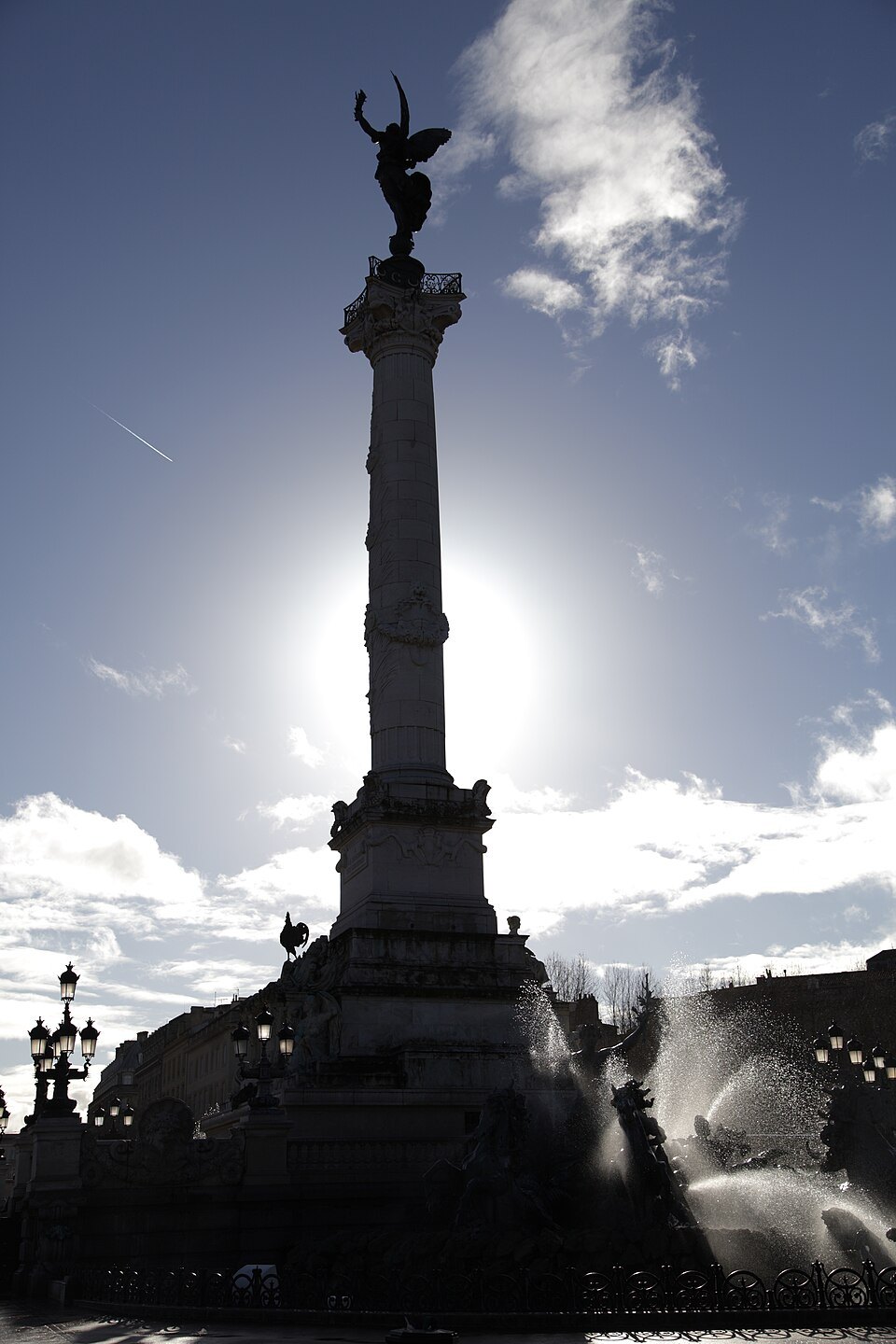
Not everyone in Bordeaux has admired the result. The writer François Mauriac thought the monument's proportions were disastrous, and his verdict is worth repeating precisely because the monument is so often praised uncritically in passing; it is fair to treat the question as one of taste rather than settled fact. Whatever one makes of the sculpture itself, the empty niches on the base and the names added only in 1989 are a reminder that the monument's history, like the political memory it was built to honor, took far longer to settle than the century between the Girondins' deaths and the first vote to commemorate them.
More from the journal
- Where to StayWhich area of Bordeaux is best for a first visit?A guide to Bordeaux's districts, from the lively old town to quieter riverside and residential quarters, for first-time visitors.Read the piece
- Getting AroundHow does the Bordeaux tram work for a visitor?A visitor's guide to Bordeaux's tram network: how it works, where to board, and how to pay for a ride.Read the piece
- When to ComeWhat happens at Bordeaux Fête le Vin, the wine festival on the quays?Every year at the end of June, Bordeaux turns its riverfront into a wine festival: tasting pavilions for the wines of Bordeaux and the region, tall ships at the quay, regional food and a show over the river at night. What to expect, and how to plan around it.Read the piece